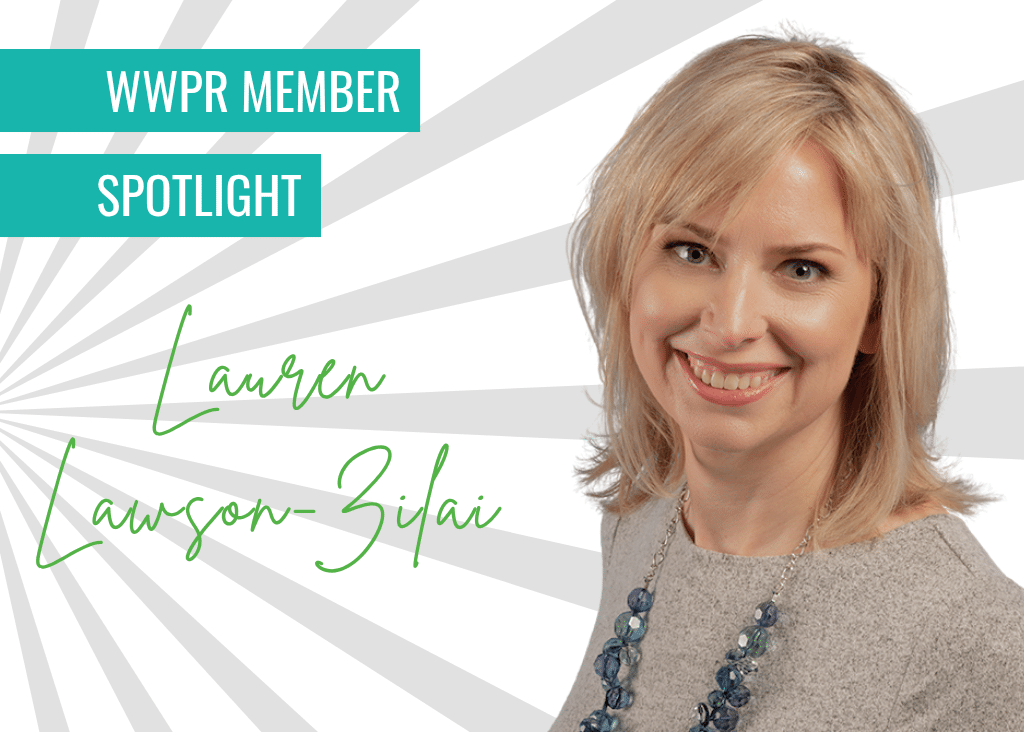
Member Spotlight: Lauren Lawson-Zilai
Written by Elisa O'Halloran
Tell us about your background and what led you to your current role. What first drew you to public relations and communications?
I’ve spent more than two decades building a career dedicated to social change and purposeful communications. My career originally started in publishing in New York, working on book publicity (think “Bridget Jones Diary”). This is where I first saw the power of media to elevate a product and the perception that often exists between the author’s vision and what the market wants. But a few months into that first job, I remember feeling unfulfilled. The community service ethic instilled in me wasn't showing up professionally and volunteering on the weekend wasn’t enough to fill the gap. I knew I needed to pivot toward nonprofit work even when family cautioned me that "nonprofit equals no money."
Seeing 9/11 firsthand as a New York resident was a turning point. It crystallized my need to be doing something that ignited real purpose rather than selling a product. I moved from New York to Washington, D.C., since it was the capital of nonprofits and associations, and I committed myself fully to working for a cause. Through networking, joining organizations like WWPR and sheer persistence, I built a path forward. My first role at the Children’s Defense Fund came through Kate Perrin (WWPR’s first PR Woman of the Year chair) and her company, PRofessional Solutions, LLC, formerly the only PR staffing agency in the D.C. area. I also believe my time chairing two pro bono committees for WWPR gave me the foundation for nonprofit work and ultimately helped me land a role leading the PR and communications team for Goodwill Industries International, one of the top five leading nonprofits in the country and the leading nonprofit workforce provider.
I spent 15 years at Goodwill and grew into senior leadership, ultimately serving as a national spokesperson. There, I oversaw large-scale communications strategies, led crisis response, built national campaigns and helped position the organization and its leadership as influential voices on workforce development and economic opportunity. More recently, I’ve held senior roles at Shatterproof and the National Head Start Association, where I led national media and communications strategies on issues ranging from addiction to early childhood education often during high-stakes, high-visibility moments.
Today, I’m the Founder and Principal of Zeal Communications where I advise mission-driven organizations and individuals on how to clarify their voice, tell more compelling stories and navigate complex communications challenges. That same ethos stays with me as I represent nonprofits and associations as well as entrepreneurs and authors who are genuinely impacting people’s lives.
What first drew me to public relations and communications was storytelling; specifically, the ability to take complex, often overlooked issues and turn them into narratives that people understand, care about and act on. Early on, I realized PR wasn’t just about promotion; it was about influence. It was about shaping conversations, elevating voices, changing perceptions and ultimately driving change. The throughline of my career has been to use strategic, purpose-driven communications to increase awareness and visibility but ultimately make a meaningful impact.
What has been one of the most exciting or rewarding projects in your career so far?
One of the most exciting and rewarding projects of my career was developing and launching Rising Together™ at Goodwill Industries International. It was a unique initiative designed to equip one million people with sustainable careers by 2025, and we secured partnerships with global philanthropic partners and Fortune 50 companies including, Bank of America, Coursera, Indeed, Google and Lyft. To see that kind of measurable, human impact tied directly to a communications campaign is why I do this work. It also resulted in an award from PRSA NCC.
On a personal level, serving as President of WWPR and Founder of the Emerging Leaders Awards was one of the most meaningful chapters of my career, allowing me to create lasting opportunities for women to be recognized, supported and inspired. Additionally, serving as President of PRSA NCC was significant because it came at a particularly challenging time, at the height of the COVID-19 pandemic. I had a long record of service with the chapter before taking the helm as vice president, assembly delegate, Chair of the Hall of Fame and Thoth Awards Gala and as co-chair of the PRSA International Conference Gala. Serving as President of the largest chapter in North America was one of the most personally rewarding leadership experiences of my career. I guided the strategic direction of a team of 40-plus, including the Board of Directors, Executive Committee and Committee Chairs. Among the accomplishments I'm most proud of were launching monthly virtual coffee chats to foster inclusiveness and networking, introducing a quarterly "DEI: Amplify Diverse Voices" series to recognize and celebrate diverse PR professionals and revamping the chapter website. On the business side, we increased revenue for professional development by 20% over two years, raised $23,000 for the chapter — exceeding our year-over-year goal by 15% and up 60% from two years prior — and secured the largest chapter sponsor in history, Amazon, at $10,000. We also developed and launched a virtual signature awards program that raised an additional $8,500. The signature awards program is the first to be held virtually to date. That time was especially meaningful and challenging as I was technically leading two full-time positions while navigating the COVID-era and managing a young child Zoom schooling at home. It showed me what I am capable of navigating. I was also grateful to be surrounded by a wonderful team, including a few WWPR members.
What advice would you give to women looking to grow in their careers or get involved in WWPR?
My first piece of advice is don't wait until you feel ready. I didn't have a perfectly mapped-out plan when I made the pivot from publishing to nonprofit work. What I had was clarity about what mattered to me and the willingness to act on it. Purpose has to lead. The rest will follow.
As far as advice for women looking to grow their careers, I recommend:
- Get cross-functional early. One of the most valuable things you can do for your career is to stop thinking of communications as a department and start thinking of it as connective tissue across an organization. At Goodwill, my team operated in a deeply cross-functional way. We had heavy collaboration and alignment meetings built into our workflow because the work demanded it. When you understand how your colleagues in programs, finance, policy and operations think, you become a far more strategic communicator. Seek out those relationships intentionally, especially early in your career.
- Build systems. Anyone can execute a one-off project. What separates good communicators from great ones is the ability to build infrastructure that outlasts them such as a story bank, a spokesperson cabinet, a campaign platform that can be activated again and again. Every time I've invested in building a reusable system rather than a single deliverable, it has multiplied the impact of everything that followed. Think about what you're leaving behind, not just what you're launching.
- Establish boundaries early and protect your time. Learn to say no to opportunities that don't align with your goals and be intentional about where you invest your energy. Boundaries allow you to show up fully for the work and relationships that truly matter to your growth.
- Lead with the human story. Before the institutional message, before the statistics, before the talking points — find the person. Every campaign I'm proudest of started with a human narrative. That is what moves people to act, give, vote, hire or change minds. It sounds simple, but the discipline of putting the story first every time is something you have to practice and protect deliberately, especially inside large organizations that want to lead with data.
- Invest in being spokesperson-ready for yourself and for others. I've spent most of my career as a national spokesperson, and that experience changed how I think about message discipline, staying calm under pressure and knowing when to speak or stay silent. Even if you never plan to be on camera, developing those instincts makes you a better strategist, a better counselor to leadership and a better advocate for your organization. And when you do prepare others for media, you'll know exactly what they need because you've lived it.
- Measure what matters. I've always pushed my teams to connect our communications work to real outcomes such as legislation affected, perceptions shifted, people placed in jobs or communities reached. When you tie your work to results that the organization actually cares about, you earn a seat at the leadership table. That discipline also makes you a better advocate for your own budget, your own team and your own value.
- Get comfortable with complexity. Some of the most important work in this field happens inside decentralized environments — national headquarters working alongside independent local organizations, each with their own cultures and priorities. My time at Goodwill and Head Start taught me to build tools and strategies that can be adapted without losing their integrity. Embrace that complexity rather than fighting it. It will make you more versatile and more valuable.
- Build your network intentionally. Join localized or specialized networking groups to share experiences, gain perspective, uncover unlisted opportunities and build a cabinet of your supporters. That is why WWPR is so important as it’s a community of women so willing to help one another and life each other up.
- Advocate for yourself. You are your own biggest proponent. Document your successes, measure the impact of your work and confidently articulate the value you bring to a brand, organization or agency. Don’t expect your work to speak for itself.
- Develop core competencies. Move beyond just pitching. Focus on cultivating strengths in executive communication, crisis management, client relations and data measurement.
- Seek out mentorship. While you need a sponsor internally at your employer, you also need a mentor. Connect with senior female communicators who have navigated agency life, in-house dynamics and career pivots.
- Set yourself up for success. When you are interviewing for a job, ensure that the organization has the support, resources and infrastructure to set you up for success in your role.
- And join WWPR. The WWPR community is one of the most nurturing, supportive and genuinely helpful professional communities I have ever been part of. It is intimate in the best possible way as you are not a name tag at a conference and people are always willing to go the extra mile to support you. I was so privileged to be a part of it and to serve as president and on the Advisory Council. The relationships I formed there have sustained me through every transition.