In our latest Board Spotlight series, get to know Janae Washington, WWPR’s Emerging Leaders Awards Co-Chair and Senior Director of Communications at the Information Technology Industry Council. From her career journey and passion for strategic communications to what inspires her work with WWPR, Janae shares more about the experiences that have shaped her leadership—and a few fun facts along the way.
Please tell us about yourself.
I’m a strategic communications leader with deep experience shaping public narratives, managing high-profile public affairs initiatives, and connecting policy priorities with diverse audiences in the public and private sectors.
I currently serve as Senior Communications Director at the Information Technology Industry Council (ITI), a global tech trade association, where I lead integrated communications campaigns on complex policy issues, including AI, economic security, and national security. In this role, I advise senior executives, drive global media engagement, and strengthen the organization’s influence and reach through digital strategies.
Prior to joining ITI, I served as Deputy Communications Director for Congressman Andy Levin (D-MI) and was a political appointee in the Executive Office of Mayor Muriel Bowser of Washington, DC, where she held public affairs roles.
I earned a Master of Public Administration and Policy from American University and am also a proud alumna of Howard University, where I received my B.A. in Sociology with a minor in African Studies and was a Fulbright-Hays Scholar.
I’m a longtime Washington, DC resident, and live in the city with my Lab-Spaniel mix, Reign.
Tell us about your background and what led you to your current role.
After a tough member-on-member primary, I felt burned out from the Hill but wanted to remain connected to policy and politics. My current role puts me at the center of some of the most consequential policy discussions while also allowing me to maintain a healthy work-life balance and unplug when needed.
What has been one of the most exciting or rewarding projects in your career so far?
In February, I had the opportunity to staff my CEO at the 2026 India AI Impact Summit in New Delhi. While on the ground, I coordinated nearly a dozen television and print media engagements, enhancing executive visibility and strengthening my organization’s reputation as a trusted, go-to source. I also helped plan and execute high-level engagements that brought together C-suite technology executives and senior government leaders from around the world to advance discussions on responsible AI, drawing standing-room-only audiences and fostering meaningful dialogue among key stakeholders.
What do you enjoy most about serving as a WWPR Board Member?
Serving as a Board Member has immersed me in the WWPR community in a meaningful way. I’ve valued the opportunity to engage with such a diverse and talented group of women, each bringing a unique perspective, story, and set of accomplishments that make our community stronger. Building these relationships with fellow women in comms has both inspired me and expanded my understanding of leadership, service, and professional growth.
How do you like to spend your time outside of work?
Outside of my communications role, I am a freelance florist and founder of my own brand, floral joy by jay. What began as a creative outlet has grown into a true labor of love. I launched the business during a season when I needed to remind myself to lead with lightness, create freely, anchor my craft in joy, and make space for something deeply fulfilling. Floral design has become both a creative pursuit and a meaningful expression of that philosophy. You can follow me on Instagram at @floraljoybyjay!
Is there a book, podcast, or resource you’d recommend right now?
My book club just wrapped up Yesteryear by Caro Claire Burke. It’s a thought-provoking read that feels especially relevant in today’s social and political climate. I’m eager to swap controversial takes with anyone who has read it!
What advice would you give to women looking to grow in their careers or get involved in WWPR?
Lean into the pivot — no matter how daunting it may seem. Some of the most rewarding opportunities come from taking an unexpected path. There is so much change happening in our industry right now, making nimbleness the name of the game.
It is hard to believe we are already halfway through 2026! As we head into summer, I have been reflecting on everything our community has accomplished together over the past six months, and I could not be more proud.
Since January, WWPR has hosted more than a dozen professional development events, welcomed new members into our growing community and continued to create opportunities for women in communications to learn, connect and lead. Through it all, we have remained rooted in our 2026 theme of pride, purpose and connection.
One of the biggest highlights of the year was our 2026 Emerging Leaders Awards. We celebrated a record-breaking attendance and recognized an incredible group of finalists whose talent, leadership and passion continue to raise the bar for our profession.
Global & Large Agency: Nia Page, chief of staff of National Geographic Content, Office of the President, The Walt Disney Company
Government: Casey Bell, public affairs officer, Education With Industry Fellow at Google Public Sector, U.S. Air Force
Trade Association: Julie Hirschhorn, manager of public relations, American Academy of Family Physicians
Corporate: Meaghan Delaney, manager, corporate affairs, KPMG US
Nonprofit: Ariana Perez, manager of public relations, Children’s National Hospital
Every finalist reminded us why the future of our industry is so bright, and I know they will continue to make an impact for years to come.
A special thank you to Julia Kreiger, head of U.S. public affairs, for delivering a phenomenal keynote address that challenged and inspired all of us.
While summer is a time to enjoy longer days, warm weather and time with friends, we are not slowing down. We have an exciting lineup of programming planned for the second half of the year that will continue to meet our members where they are, whether they are building new skills, growing their networks or advancing their careers.
I am especially looking forward to our third signature event of the year, the Woman of the Year Awards, where we will once again celebrate the outstanding women who continue to shape our profession and our community.
Thank you for being part of WWPR and for helping make this organization such a welcoming and inspiring place. I hope to see you at one of our upcoming events.
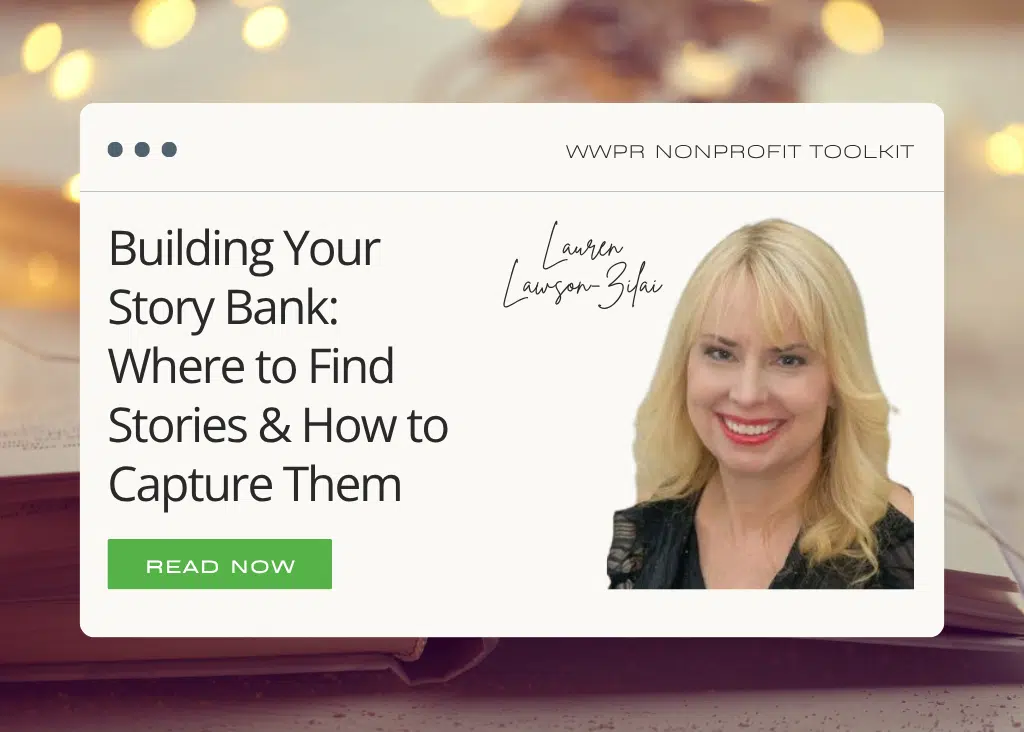
By Lauren Lawson-Zilai, Founder and Principal of Zeal Communications
This resource is the fifth in the WWPR Nonprofit Communications Toolkit, a year-long series of practical guides designed specifically for small to mid-sized nonprofits working with limited staff and budgets. Each guide is designed to be immediately implementable without prior communications experience or expensive tools. Explore more resources at wwpr.org/nonprofit-toolkit. For questions or feedback: probono@wwpr.org.
Uncover your organization’s best stories to boost visibility, expand influence, and inspire action.
Introduction: Every Organization Has a Story
Your organization changes lives. But if no one outside your walls knows how, the mission stays small. The stories that could change that are closer than you think. They are buried in a staff meeting update, a client’s offhand comment, or a quiet milestone no one thought to write down. Every organization has meaningful stories to share. They are the human evidence of your work, providing a reason for people to believe in your mission. Yet for many nonprofit and association teams, especially small ones, finding and capturing those stories consistently feels like one more thing on an already demanding list.
You already know how powerful stories are. They build understanding, strengthen trust, and remind your audiences why your work matters, turning passive audiences into passionate advocates. A single story told well can do what a year of press releases cannot: move someone to give, volunteer, champion, or simply pay attention.
The challenge is not that organizations lack stories. The challenge is building a system to find them, capture them, and keep them flowing even when your team is small, your bandwidth is limited, and storytelling competes with every other organizational priority.
This toolkit is designed to help communications professionals do exactly that, and create emotional, relatable narratives that will inspire action.
Grab a notebook or open a doc and jot down ideas as you go through this guide. Do not overthink it. Small wins and real moments often turn into the most powerful PR opportunities.
This guide addresses the following:
Why stories matter more than statistics
The five places to look for compelling stories inside your organization
Practical, low-lift systems for capturing narratives year-round
The anatomy of a story worth telling
How to evaluate whether a story has media potential
Ethical storytelling principles every team should follow
Work through it at your own pace. Return to specific sections when you need a fresh batch of ideas. And remember: the best story bank is one that grows a little every week, not one you build in a single afternoon.
Why Stories Matter More Than Statistics
Research consistently demonstrates that a narrative is a more effective vehicle for persuasion and retention than data presentation alone. According to Braddock and Dillard (2016), narrative communications can be up to 22 times more memorable than facts presented without a story context. This advantage is especially significant for mission-driven organizations that rely on public trust, donor investment, and stakeholder engagement.
For nonprofits and associations, the communications challenge extends beyond product promotion. Organizations are asking audiences to believe in a mission, invest in a community, and trust that the organization is the appropriate vehicle for the investment. As of 2025, there are approximately 1.9 million registered nonprofits in the United States that feed, heal, shelter, educate, and inspire people of every demographic (National Center for Charitable Statistics, 2024). In this crowded landscape, stories are the primary mechanism through which organizations differentiate themselves and build lasting credibility.
Uri Hasson, a professor of psychology and neuroscience at Princeton University and a neuroscientist whose work is highly relevant to storytelling and communications, has demonstrated through neuroimaging research that storytelling produces measurable effects on brain activity and retention. Specifically, his research indicates that a story activates parts of the brain that allow the listener to convert narrative into their own ideas and experiences. While the processing of facts engages only two areas of the brain, a well-told story engages many areas simultaneously. Furthermore, when the brain experiences an emotionally charged event and anticipates resolution, it releases dopamine — a neurochemical that enhances memory retention and accuracy.
Stories Do
Stories Don’t
• Create emotional connections between your mission and the people who can support it.
• Build credibility that no statistic, report, or press release can replicate.
• Help donors, policymakers, and partners understand the human stakes of your work.
• Sustain engagement across channels including social media, email, events, and media.
• Rely on data without a human face to accompany it.
• Speak in program language when plain, personal language would land harder.
• Wait for the perfect story when a small, honest moment will do.
• Underestimate the power of your own team’s lived experience.
The organizations that appear consistently in media coverage, in donor awareness, and in community discourse are not necessarily the largest or best-funded. They are the ones who have developed the capacity to tell their stories with clarity, confidence, and consistency. This is a learnable skill that improves with practice and with the right organizational systems supporting it.
Where to Look for Stories
Compelling stories can be found in five key areas within any organization. Each source requires a slightly different approach, but together they provide a steady, renewable pipeline of narrative material. The following sections present story prompts and questions to help communications professionals identify, surface, and develop story ideas from each source.
1. The People You Serve
The most powerful stories in any nonprofit organization belong to the people the mission exists to support. These are the stories of transformation: before and after, struggle and growth, or challenge and possibility. They represent what donors fund, what policymakers need to hear, and what the media most wants to tell.
Recommended story prompts include the following:
Who has experienced a meaningful change because of the organization’s programs or services?
What was at stake for them before connecting with the organization?
What specific moment marked a turning point in their experience?
What does their life, work, or opportunity look like now?
Would they be willing to share their story, and in what format?
Ethical Note
Always lead with dignity. Every person whose story is shared is a full human being, not a symbol of need.
2. Your Staff and Volunteers
The individuals who carry out an organization’s mission on a daily basis represent a significant storytelling resource. Their motivations, experiences, and behind-the-scenes perspectives reveal the organizational culture and commitment that differentiate one nonprofit from another. These stories humanize the organization’s public presence and contribute to internal morale and staff engagement.
Recommended story prompts include the following:
Why did this person choose to work or volunteer with this organization?
What moment made the mission feel most real to them?
What does a typical day look like, and what is quietly extraordinary about it?
What have they witnessed that surprised, moved, or changed
3. Your Programs and Milestones
Every organizational program generates data, and behind every data point is a human story. Anniversaries, funding milestones, new initiatives, advocacy actions, and program expansions are all narrative opportunities that can be framed for various audiences and channels.
Recommended story prompts include the following:
What program milestone is approaching, such as an anniversary, a participant count, or a geographic expansion?
What problem did this program solve that did not have a solution before?
What has surprised you about how the program has evolved?
Who was the first person served by this program, and where are they now?
What would not exist in this community if the organization had not acted?
4. Your Community and Partners
Nonprofit organizations do not operate in isolation. The partnerships built, coalitions joined, and community contexts navigated are all sources of storytelling material. These stories expand organizational reach, demonstrate credibility, and position the organization as a connector and collaborator within the sector.
Recommended story prompts include the following:
Which partnership has created an outcome neither organization could have achieved independently?
How has the community context, including policy, demographics, or economic conditions, shaped organizational priorities?
Who in the organization’s network has a story that connects to the mission?
What would community leaders say about the gap the organization fills?
What challenge is being faced collectively that the public should know about?
5. The Organization’s Own Journey
The founding story, organizational evolution, periods of difficulty, and moments of achievement are all components of a larger institutional narrative that merits telling. Organizational stories build institutional credibility and provide audiences with a sense of legacy, progress, and purpose.
Recommended story prompts include the following:
Why was this organization founded, and what was the moment that identified the need?
What is the most significant change the organization has navigated?
What lesson was learned the hard way that shaped current operations?
What does this organization stand for that most people do not know?
Where is the organization headed, and why does it matter now?
How to Capture Stories: Systems That Work for Small Teams
Even the most compelling story ideas will not surface without intentional systems to identify them. The following approaches are designed to make storytelling a natural, low-effort component of organizational operations rather than a special project requiring dedicated sprints. Most of these systems require fewer than 30 minutes to set up. The primary discipline is in returning to them consistently.
Sit In on Team Meetings
Communications professionals who join program, fundraising/development, operations, mission, or partnerships meetings on a monthly basis will regularly encounter informal updates that represent strong story leads. Staff members often mention participant breakthroughs, funder responses, or community challenges in passing. These offhand observations are frequently the seeds of the most compelling organizational narratives. Communications staff should attend with a notes app open and capture any detail that produces an emotional response.
Some organizations open monthly staff meetings or town halls with a designated “mission moment.” These brief shares represent an efficient opportunity to capture stories suitable for media interviews, blog posts, or podcast appearances. Additionally, grant interim reports submitted to foundations and donors often require personal narratives from program participants and represent an additional source of story material.
Create a Monthly Story Share Communication
A short email or internal Slack/Teams message to staff monthly with two or three prompts drawn will surface material that would not otherwise be reported through formal channels. Staff should be asked to share recent wins, memorable moments, or participant interactions that stayed with them. A content calendar shared internally allows colleagues to think proactively about potential stories for time-sensitive opportunities. When stories are published, sharing them with key stakeholders and potential partners creates cross-posting opportunities that extend reach.
Sample prompts for a monthly Story Share:
• Share one moment from this month that reminded you why we do this work. • Tell me about a participant, family, or community member who stood out to you recently. • What is something small that happened this month that deserves more attention? • Is there a challenge we are facing that the public does not understand but should?
Review Internal Reports
Impact metrics, client feedback forms, program notes, and staff reports represent significant untapped story resources. The goal of this review is not to identify the statistic but the story behind it. When a metric changes substantially, the follow-up question is why. When a client leaves a comment, the follow-up question is who. When a program reaches a milestone, the follow-up question is what it took to get there. The data functions as a map; the story is the destination.
Follow Staff on Social Media
Staff members frequently share personal or behind-the-scenes moments on social media platforms that could generate PR opportunities. A photograph from a site visit, a reflection following a difficult day, or a casual post about a community event can indicate stories that would not appear in an internal report. Following staff accounts provides communications professionals with an additional channel for story discovery.
Host a Quarterly Story Roundtable
Convening colleagues from different departments, including programs, public affairs/public policy, development, communications, and operations, for approximately one hour per quarter produces story material that siloed team structures rarely surface. These conversations can be incorporated into staff retreats. Cross-departmental dialogue consistently reveals the strongest organizational narratives because participants from different vantage points perceive different dimensions of the same experiences.
Roundtable starter questions:
• What is the most interesting thing that has happened in your work this quarter? • Who have you met recently that we should know more about? • What challenge are we facing that is not being talked about enough? • What would surprise our donors or supporters if they knew it? • What moment from this quarter should we never forget?
Ask Department Leads for One Highlight a Month
Adding a standing item to monthly leadership check-ins requesting one story highlight from each department creates a reliable pipeline of narrative material. Using a shared form such as JotForm or a Wufoo form to collect these highlights produces an institutional memory that also functions as a content calendar. Posting the form on the organizational website alongside a consent and release form allows staff to direct program participants and community members to share their own stories directly.
Build a Story Tracker
A simple story tracker does not require specialized software. A shared Google Sheet, spreadsheet, or Notion page with five columns is sufficient to maintain an organized, actionable pipeline. The five recommended columns are as follows: (a) Subject — who or what the story is about; (b) Source — who flagged the story and who must be contacted; (c) Type — participant impact, staff story, milestone, partnership, or organizational journey; (d) Best channel — media pitch, blog, social media, newsletter, donor communications, or speaking opportunity; and (e) Status — idea, in development, ready to pitch, or published. The tracker should be reviewed monthly, published stories archived and the pipeline kept active.
The Anatomy of a Story Worth Telling
Not every moment becomes a story. However, those that do tend to follow a recognizable structure. Understanding that structure helps communications professionals recognize story potential when they encounter it and guide others in sharing their own narratives.
The Five Elements of a Compelling Organizational Story
Element
What It Covers
Questions to Ask
1. The Person
Who is this story about?
Give them a name, a detail, a moment that makes them real. Who are they beyond their connection to your organization?
2. The Challenge
What were they facing?
What was at stake? What was the obstacle, the gap, the barrier, or the struggle? This is where empathy begins.
3. The Turning Point
How did your organization enter?
What changed and why? What specific action, program, or connection made the difference?
4. The Outcome
What does transformation look like?
Be specific. A milestone, a moment, a new possibility. Avoid vague language like ‘They thrived.’ Show and demonstrate it.
5. The Connection
Why does this matter now?
Link the story to your mission. What can the audience do: give, advocate, share, or show up?
Once these five elements are identified, the story exists. The format — a blog post, a media pitch, a social post, a donor letter, a 60-second verbal share — is a secondary decision. Establishing the elements first ensures that the story is substantive regardless of the channel through which it is delivered.
Turning a Story Into a Media Opportunity
Not every organizational story is suitable for a media pitch, but more are than communications professionals typically assume. Once story ideas have surfaced from the story bank, four filters can be applied to assess media potential. This chart represents those filters.
Filter
What to Ask
Timely
Is this story connected to a recent event, current policy debate, seasonal moment, awareness month, or emerging trend? Timeliness is the single most important factor for media interest.
Leadership or Innovation
Does this story demonstrate something that is new, better, or different? Reporters and editors are drawn to what is working and what others should know about.
Real Impact
Does the story illustrate impact through a real person, a specific outcome, or a meaningful insight? Data without a human face rarely moves an audience.
External Curiosity
Would someone outside the organization, such as a reporter, a podcast host, or a community leader, find this genuinely interesting? If the answer is yes, it is worth pitching.
If your story meets two or three of these criteria, it warrants further development. A strong story meeting two filters is more valuable than a mediocre story meeting all four. New initiatives and grant investments are frequently covered in the media due to human-interest narratives rather than the substantive details of a program or investment.
Pro Tip
Stories that center real people and specific outcomes consistently outperform organizational announcements, even when the announcement is significant. Leading with the human and then connecting to the institutional news is the recommended approach.
Ethical Storytelling
Powerful storytelling carries serious ethical responsibility. The individuals whose stories are told by nonprofit organizations and associations are frequently in positions of vulnerability — as program participants, as community members navigating hardship, or as staff sharing personal experiences. How organizations handle these stories reflects directly on institutional integrity.
Four Non-Negotiable Principles
Dignity First
Every person in an organizational story is a full human being, not a symbol of need, a cautionary tale, or a fundraising mechanism. Stories that reduce individuals to their hardship without acknowledging their strength, agency, and complexity are both ethically problematic and less effective as communications tools. The most powerful stories honor the whole person. Person-first language should be used consistently to place the individual before their condition or circumstance, reducing stigma and reinforcing full humanity.
Informed Consent
Anyone whose story is shared must understand clearly how that story will be used, where it will appear, and who will see it. This includes whether the individual’s full name or first name only will appear, what specific publications or platforms will publish the content (print, website, interactive map, etc.), and whether a photograph will be used. Individuals must have the genuine right to decline, and that right must be respected without pressure or consequence. Whenever possible, subjects should review the story before publication.
Organizations should consult legal counsel as several best practices govern ethical consent in organizational communications. First, consent should not be granted in perpetuity. While few legal requirements address consent duration outside of health organizations — which must comply with the Health Insurance Portability and Accountability Act (HIPAA) — best practice recommends a consent window of three to five years. The Better Business Bureau (BBB) requires a minimum of three years. Practically speaking, however, using a story or image that is three to five years old in a new communications product raises questions of relevance, with the exception of historical retrospectives.
Second, organizations should provide the individual with a digital or paper copy of the consent form and a leave-behind document summarizing what was consented to, along with a point of contact should the individual wish to withdraw consent. The right to rescind is a critical component of ethical storytelling practice. Failure to uphold this standard can result in significant reputational harm to an organization.
Third, consent protocols must specifically address minor children. Minors cannot legally sign consent forms; therefore, organizations should establish a formal policy requiring that only a parent or legal guardian provide consent on a child’s behalf. Teachers, camp counselors, and community leaders are not authorized signatories. As an additional best practice, adolescents ages 14 to 16 should be asked to co-sign consent forms alongside their parent or guardian. Organizations should track these assets and, when a minor reaches the age of 18, seek renewed consent if those assets remain in active use. While not a legal requirement, this practice prioritizes dignity, agency, and individual choice.
Consent is a continuing conversation, not a one-time transaction.
Accuracy and Context
Stories should never be oversimplified, sensationalized, or stripped of the contextual details that make them true. The full truth, told well, is always more powerful than a dramatic version that sacrifices accuracy for emotional impact. If the accuracy of a detail cannot be verified, it should be omitted until verification is possible.
Center the Voice
Whenever possible, individuals should speak for themselves. The role of a communications professional or organizational leader is to amplify, not to author. Stories should be genuine, authentic, and told in the subject’s own words. Communications professionals should resist the impulse to translate, polish, or editorialize to the point where the subject’s voice disappears from their own narrative.
Ethical storytelling checklist — before you publish or pitch:
• Have I obtained informed consent from everyone named or identifiable in this story? • Does this story represent the person’s full humanity, not just their need or struggle? • Have I verified the facts and avoided oversimplification? • Does the subject know how and where this story will be used? • Would this person be proud to see this story in print or hear it at an event? • Am I centering their voice, or have I replaced it with my own interpretation?
Story Bank Quick-Start Plan
The following four-week plan is designed to help communications professionals establish a functioning story bank regardless of team size or prior experience. This table presents the recommended activities for each week.
Week
Your Focus
Week 1
Establish the story tracker. Review each of the five story sources. Write down three story ideas based on existing organizational knowledge — people, programs, or moments that come to mind readily. Record without filtering.
Week 2
Send the first Story Share email or internal message to staff. Use two or three prompts from this guide. See what surfaces. Add promising responses to the tracker.
Week 3
Attend one team or program meeting. Document observations that produce an emotional response (surprise, pride, sadness, inspiration, etc.) Identify one potential story for further development.
Week 4
Apply the four media pitch filters to the top story idea. Determine the appropriate channel: media pitch, blog post, social feature, or donor communication. Identify and take one step toward publication.
After 30 days, the organization will have a functioning story bank, a system for maintaining it, and at least one story ready to develop. For many organizations, this represents the communications infrastructure foundation on which all subsequent storytelling capacity is built.
“Each story we tell is a small flicker of light. Enough of them, and we set the world on fire.” — Brené Brown
Your stories are already out there. This toolkit is your map to find them.
About the Author: Lauren Lawson-Zilai is the Founder and Principal of Zeal Communications,a communications consultancy that helps mission-driven organizations and entrepreneurs amplify their impact through purposeful, results-oriented communication. Previously, she held senior leadership roles at organizations including the National Head Start Association and Goodwill Industries International, where she served as national spokesperson and led media relations, crisis communications, partnership cultivation, and multi-channel storytelling initiatives.
Lawson-Zilai is a former President of Washington Women in PR and board member, where she served for six years in roles including Pro Bono Chair and PR Woman of the Year judge. She founded the Emerging Leaders Awards, served on the WWPR Advisory Council, and is a PR Woman of the Year honoree.
Every year, the Washington Women in Public Relations (WWPR) highlights the brightest young minds (ages 25-35) navigating the high-stakes world of DC communications. The 16th Annual Emerging Leaders Awards (ELAs) finalists represent a masterclass in modern storytelling, crisis management, and strategic brand building across agencies, corporations, government, and nonprofit organizations.
But while these women are experts at shaping narratives for major global brands and critical policy initiatives, we wanted to pull back the curtain on how they shape their own careers. Their collective perspective offers something valuable for communicators at every stage of their careers: practical, hard-earned advice on how to grow, lead, and make an impact early.
Ahead of the awards ceremony on Thursday, June 25 from 6-8PM at the AT&T Forum where a winner in each category will be revealed, we asked our 2026 finalists to share their best piece of career advice for the next generation of leaders. Whether you are just getting started in communications or looking for a fresh perspective on your next career move, these insights serve as a reminder that leadership is built one opportunity, one challenge, and one thoughtful decision at a time.
Here’s what they shared:
Small/Boutique Agency
Natalia Gonzalez, Account Director | Beekeeper Group
“Surround yourself with people who challenge you, push you to grow, and show up when it matters. The relationships you build will shape your career more than any title or credential. And stay flexible — this field changes constantly, and the professionals who thrive are the ones who adapt without losing sight of what they stand for.”
Mary Lieb, Director | Signal Group DC
“The most effective communicators are always the most intentional listeners. Lead with curiosity and use understanding to shape your message.”
Emily Tillet, Vice President | Jasper Advisors
“In PR and communications, your unique perspective is the very asset clients are paying for, so never let a junior title or a room full of high-profile people silence your insights. Own your seat at the table by speaking up with conviction, knowing that fresh, strategic thinking holds just as much weight as decades of experience in any boardroom, courtroom, or stadium.”
Mid-Sized Agency
Elizabeth Brown, Associate Vice President | Precision
“Follow the people and causes that matter most to you. It will make the work of telling their stories that much more enjoyable.”
“Stay open to opportunities. The role or platform that ultimately shapes your career may not even exist yet — build genuine relationships, stay curious, and learn something from every role and every person you meet. Your network, your reputation, and your adaptability can open doors you never saw coming.”
Hannah Rosichan, Senior Managing Director | PLUS Communications
“Stay curious, detailed, steady under pressure and never stop studying the people around you. There is something to learn from every smart person you work with. Maybe most importantly, read the news every single day — never underestimate the power of being the best-read person in the room.”
“While working in communications means you often need to work fast and efficiently, don’t be afraid to speak up and provide insights that will strengthen the message or strategy. Some of the most valuable contributions you can make come from trusting your instincts and bringing a thoughtful, confident perspective to the table.”
Global/Large Agency
Molly Mitzner, Vice President | Allison Worldwide
“You never know if you don’t ask: making things happen starts with being brave! The worst thing that can happen is someone says no and moves on. Big impact comes from taking small steps.”
Nia Page, Chief of Staff of National Geographic | National Geographic
“Do not underestimate the value of the work happening behind the scenes. Every task is part of a larger story, and every contribution helps move the work forward. Take pride in all of it, especially the parts that go unseen. More often than not, the moments that receive the applause are made possible by countless acts of excellence that happened quietly in the background.”
Allison Starego Vice President | Edelman
“Remember that this industry is a team sport. The most impactful work comes from collaboration, mentorship, and mutual support — success in our field is rarely the result of one person’s efforts alone, and investing in the growth and success of others naturally elevates teams, organizations and the profession as a whole.”
Government
Casey Bell, U.S. Air Force Public Affairs Officer/Education with Industry Fellow | U.S. Air Force/Google
“As women, your best asset is your instinct. Absorb the knowledge, trust yourself in the messy experiences, and never let a mistake define you — let it refine you.”
Brianna Klipp, Proposal Specialist | Cision US, Inc.
“Do not wait until you feel overqualified to pursue something meaningful. Some of the most transformative opportunities come from taking thoughtful risks, staying curious, and being willing to learn across disciplines. Resilience matters just as much as talent.”
Jasmine Washington-Price, Media Relations & Internal Communications Coordinator | Alexandria City Public Schools
“Trying to break into the communications and public relations field can be challenging, but don’t give up. Landing my first PR job after college wasn’t easy, but I prioritized continuous learning, leaned on my network while continuing to expand it, and stayed committed to growing both personally and professionally.”
Nonprofit
Aliza Bran, Director of Media Relations | International Spy Museum
“Consume the world around you with curiosity — read books, enjoy music, stay in touch with the cultural conversation, watch trending shows or niche movies, build your knowledge base — and find creative ways to connect your content with what you find. The one thing that technology will face the most difficulty replacing is the bizarre and innovative workings of your unique perspective.”
Ariana Perez, Manager of Public Relations | Children’s National Hospital
“Work hard, stay curious, and believe in the mission behind your work. The most rewarding part of communications is uncovering stories that deserve to be told and helping them reach people who need to hear them. When you lead with purpose and passion, your work can make a meaningful impact far beyond the headlines.”
Melissa Toufanian, Managing Director | Navigator Research
“Whether it’s communications and PR or any other field, never be afraid to ask questions! Speak up in the meeting, reach out and ask someone you admire about their career, or simply ask the question that others are surely thinking but not saying. You won’t regret it!”
Corporate
Shannon Casey, PR Manager for AI & Machine Learning at AWS | Amazon
“Be loud and be curious. Build real relationships with reporters, your spokespeople, and your coworkers over coffee. Raise your hand for new opportunities and showcase your wins — advocate for yourself.”
Meaghan Delaney, Manager, Corporate Affairs | KPMG US
“Stay current on high priority topics and external dynamics that can have an impact on your client or organization. Build a strong network both inside and outside your organization, and use where you live to find others with similar career interests.”
Danesha Price, Director of Marketing and Events | Washingtonian Magazine
“Invest in your own growth, trust your instincts, and never stop pursuing the experiences and relationships that remind you of your worth.”
Victoria Vinall, Senior Policy Communications Manager | Aurora Innovation
“Show up to every happy hour, write with brevity, and be reliable.”
Trade Association
Dara Cohen, Senior Director, Strategic Communications & Media Relations | American Gaming Association
“Believe in yourself and don’t be afraid to take up space, push for new ideas, and challenge the status quo. Some of the biggest opportunities come from being willing to take risks, speak up, and hold yourself accountable once you’re in the room.”
Julie Hirschhorn, Manager, Public Relations | American Academy of Family Physicians
“Nobody really has it all figured out, so trust your instincts, speak up and don’t let uncertainty shake your confidence. And never underestimate the value of relationships — some of the best opportunities come from simply being thoughtful, dependable and staying connected to people over time.”
Alexandria Kinsey, Digital Marketing and Communications Specialist | College of American Pathologists
“Don’t be afraid to take up space in rooms where your presence was requested. Don’t let anyone question your skills, knowledge, or instincts.”
Their advice is a timely reminder that success in this field is not only about expertise, but also about resilience, generosity, curiosity, and a willingness to keep evolving. We look forward to spotlighting their voices, sharing their insights, and recognizing the remarkable contributions they are already making across the communications profession and hope you can join us.
WASHINGTON—Today, Washington Women in Public Relations (WWPR), a professional development and networking organization for female communicators in the nation’s capital, announced the finalists for its 16th Annual Emerging Leaders Awards (ELAs).
The ELAs honor outstanding professionals (ages 25–35) who are making a remarkable impact early in their PR careers. This year, WWPR is proud to spotlight trailblazing young women throughout the DC area who are leveraging innovation, elevating critical narratives, and navigating the evolving communications landscape with relentless creativity and conviction.
The 24 finalists are grouped into the following categories, Small/Boutique Agency, Mid-Size Agency, Large/Global Agency, Government, Non-Profit, Corporate, and Trade Association. One winner from each category will be revealed on Thursday, June 25 from 6-8PM at the AT&T Forum, 601 New Jersey Avenue NW, during an evening of networking, inspiration, and celebration.
This year’s finalists represent the top candidates in each of the seven categories, as determined by a distinguished panel of judges. The 2026 ELA finalists are:
Small/Boutique Agency
Natalia Gonzalez, Account Director | Beekeeper Group
Nia Page, Chief of Staff of National Geographic | National Geographic Content (Owned by the Walt Disney Company)
Allison Beres, Vice President | Edelman
Molly Mitzner, Vice President | Allison Worldwide
Government
Casey Bell, US Air Force Public Affairs Officer/Education with Industry Fellow | US Air Force/Google
Brianna Klipp, Proposal Specialist | Cision US inc.
Jasmine Washington-Price, Media Relations & Internal Communications Coordinator | Alexandria City Public Schools
Nonprofit
Aliza Bran, Director of Media Relations | International Spy Museum
Melissa Toufanian, Managing Director | Navigator Research
Ariana Perez, Manager of Public Relations | Children’s National Hospital
Corporate
Meaghan Delaney, Manager, Corporate Affairs | KPMG US
Victoria Vinall, Senior Policy Communications Manager | Aurora Innovation
Shannon Casey, PR Manager for AI & Machine Learning at AWS | Amazon
Danesha Price, Director of Marketing and Events | Washingtonian Magazine
Trade Association
Dara Cohen, Senior Director, Strategic Communications & Media Relations | American Gaming Association
Julie Hirschhorn, Manager, Public Relations | American Academy of Family Physicians
Alexandria Kinsey, Digital Marketing and Communications Specialist | College of American Pathologists
“As a former recipient, the Emerging Leaders Awards is close to my heart both personally and professionally and remains a career highlight,” said Charmaine Riley, president, WWPR. “Now in its 16th year, the Emerging Leaders Awards continues to lift up DC’s brightest young PR professionals who are redefining excellence and shaping the future of our industry. We look forward to toasting to the 23 finalists and celebrating their incredible accomplishments.”
Julia Krieger, Head of U.S. Public Affairs at Coinbase, will serve as the keynote speaker for this year’s event. The awards celebration will be held at 601 New Jersey Avenue NW, Washington, DC, on June 25 from 6:00 p.m. to 8:00 p.m. Reserve your spot today.
Washington Women in Public Relations (WWPR) is a member-based professional society cultivating and inspiring female communicators to reach their full potential in the DC market and beyond. The organization is committed to providing leadership opportunities, professional development, mentorship, and industry networking. Visit us at wwpr.org, connect with us on LinkedIn and Facebook, and follow us on Twitter @WWPR and on Instagram @WWPRDC.
For more information, Contact Emerging Leaders Awards Co-Chairs Janae Washington or Isabel Aldunate at ela@wwpr.org.
Stay connected with WWPR by signing up for our mailing list! You’ll receive the latest updates on professional development events, exclusive networking opportunities, leadership initiatives, and more!